

Are we being eco-friendly by choosing vintage?
The limits of growth
Most great civilisations before us collapsed for one simple reason: they failed to manage the way they extracted and used resources. They grew too large, too dependent, too greedy. Supplies began to run out, shortages appeared, hunger followed, unrest grew — or the environment was degraded so severely that even small climatic shifts became enough to push an entire system beyond its limits. And the climate has always been changing. This is not a phenomenon unique to our time.
I am increasingly convinced that today we stand at the edge of a similar crisis. This is not a dramatic, catastrophic prediction, but a conclusion drawn from data, statistics, and the direction in which the world is moving.
This will not be a historical or anthropological essay. though. Rather, it is a short reflection on what we do, and what the real environmental cost of it is.
Mid-Century Modern versus planned obsolescence
Is vintage just another fashionable word — and a form of greenwashing?
No. Anything that gets a second life, anything reused rather than replaced, anything that extends the life cycle of an object, has a real impact on the future. It influences what our everyday life will look like in fifty years.
From the second half of the 20th century — and especially since the early 2000s — we have been surrounded by planned obsolescence. A deliberate shortening of product lifespan in order to push new versions onto the market. Companies spent enormous budgets convincing consumers that something was already outdated, no longer cool, no longer desirable — or they simply made objects in a way that caused them to wear out faster.
From the perspective of a factory owner, the logic is clear: a production line has to run non-stop, and the world has to consume in huge quantities. Ideally, products break one day after the warranty ends.
But both the environment and the end customer lose in this model — whether or not they fully realise it.
They say we have already produced enough chairs for generations. If we distributed all the chairs that already exist, every person on the planet could have their own — and there would still be enough left for our children. And yet production does not slow down.
A very different set of values
The Mid-Century era was guided by completely different ideals. In the 1950s and 60s, physical work and craftsmanship were respected and well paid (something that is now coming back with surprising force), and skilled labour came with pride. Globalisation had not yet reached its current scale, so production was largely aimed at local markets. Often, the person making a piece of furniture and the person buying it would drink coffee in the same café.
In that context, nobody wanted to produce cheap junk. Production was not anonymous — and it was genuinely satisfying to say: this is what we made.
Today we happily list the names of small Danish towns (Søborg, Randers, Silkeborg) where funriture was made as part of the story — because it adds meaning and value to a piece. But back then, this level of quality was simply normal, even in modest local factories. The general goal was to produce furniture that was solid, built to last, intended for years — ideally for life, perhaps even longer.
One more point is worth remembering: at the time, access to raw materials was almost unlimited — especially high-quality timber. Today that is no longer the case. And when it is available, it comes at a very high cost.
Mid-Century therefore offers not only craftsmanship, but also something increasingly rare: materials of a quality that is difficult to replicate today at scale.
Vintage — what does it actually mean?
The word vintage comes from the world of winemaking. Originally, it referred to a particular year and the quality of the harvest. It quickly entered the language of fashion — and later interior design. Today it describes objects that are more than twenty years old.
If we consider that the vintage trend began spreading widely in the 1980s and 90s, it is hard not to see it as a response to a cultural shift: a longing for quality and longevity — at the very moment mass production started moving to Asia.
Vintage is not a greenwashing label. It is a genuine appreciation for well-made objects from the past — objects that bring real benefits both to the environment and to the buyer.
Above all, vintage is a choice of quality over quantity. If we buy one beautiful table, perhaps it can stay with us for a very long time — or even forever. And if we count how many low-quality tables we have thrown away simply because they fell apart, we may realise that it would have been enough to buy one truly durable piece.
By choosing vintage furniture, we give forests a little space to breathe — and we relieve, at least in part, underpaid factory workers in China (and many other countries). We also stop contributing to the mountains of waste we complain about, without really asking why they keep growing.
Overfilled landfills will soon become one of our biggest problems. We should take an honest look at how much we throw away. Waste does not disappear — it has to be stored somewhere, buried somewhere, accumulated somewhere. And an enormous part of it cannot realistically be recycled at all.
Choosing vintage is choosing ecology and long-term thinking — not the “eco” of glossy bank advertisements, but the real, carefully considered kind.
A good example of sustainable development and the circular economy has been proposed by the European Parliament. The direction is ambitious, but in my opinion it is also inevitable — economically as much as environmentally.
You can learn more here:
Gospodarka o obiegu zamkniętym: definicja, znaczenie i korzyści
The future: recovery and upcycling
For geopolitical and economic reasons, we may soon be “forced into” vintage — at least to some extent. Cheap production in Asia is coming to an end. Local societies no longer want to work for pennies. They are building strong domestic markets. At the same time, trade wars and tariffs have begun raising the cost of importing cheap furniture, clothing, and everyday goods.
It may be worth investing in vintage now, while the selection is still wide and prices are still relatively reasonable (even if they are rising very quickly).
We will likely develop more technologies focused on recovering valuable materials, and the design world will increasingly turn towards upcycling. Hopefully it will be as beautiful and as well thought-out as possible.
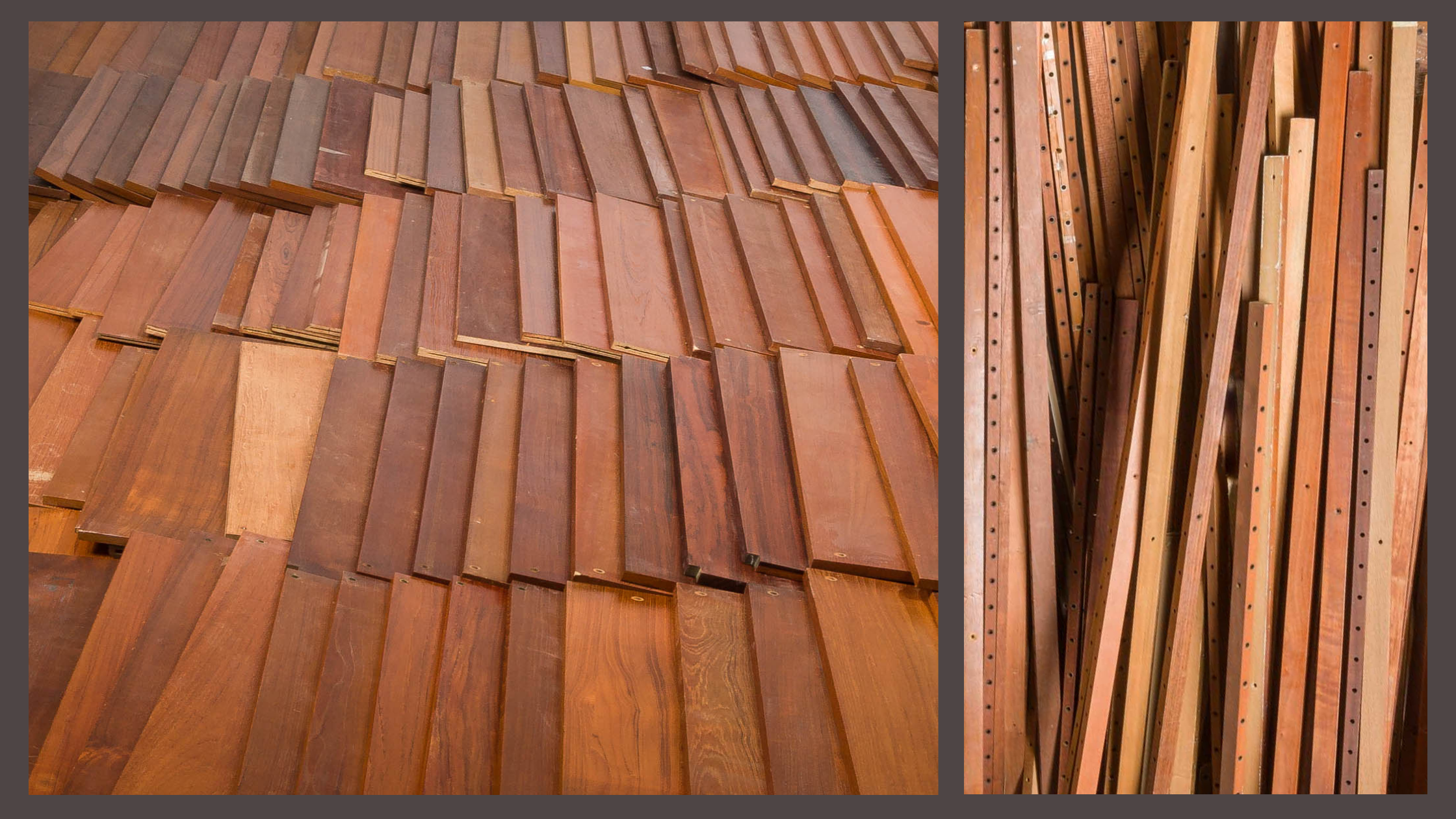
On our side, we have already started experimenting with upcycling — especially with pieces that are heavily damaged or simply impossible to save.
Judge for yourselves whether it makes sense. We will be grateful for your comments. Below our humble beginnings with upcycling.
Adam Krzeminski,
e-mail : shop@futureantiques.eu
Tél. : 502 320 271

Adam Krzemiński – PDG
Adam Krzemiński est diplômé en droit, mais sa passion pour l'archéologie l'a conduit à la découverte et à la restauration de meubles, qu'il considère comme des objets historiques. Il a commencé par restaurer des antiquités en Europe et aux États-Unis, mais s'est rapidement intéressé aux pièces du XXe siècle. En 2014, il a fondé Futureantiques, une entreprise spécialisée dans le mobilier et l'éclairage modernes du milieu du siècle. À ce jour, les articles de la collection Futureantiques ont trouvé de nouveaux foyers chez des clients dans plus de 27 pays, 400 villes et sur quatre continents.


 English
 Polish
 French
 German